Media Room
Media Coverage
Jan2026
GD Goenka International School, Surat Shines at CBSE National Science Exhibition 2025–26


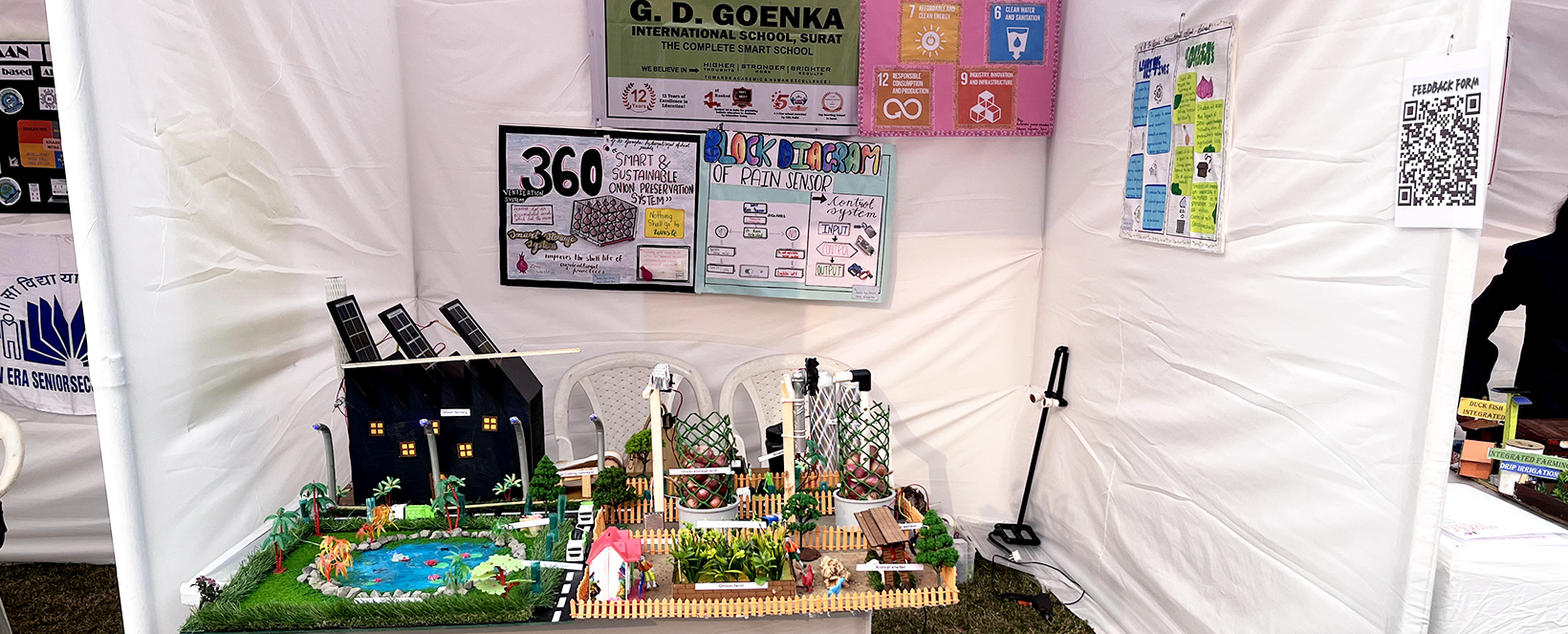
G.D. Goenka International School, Surat is proud to announce a remarkable achievement at the CBSE National Science Exhibition 2025–26, organized at Delhi Public School, Mathura Road, New Delhi, from 15th to 17th January 2026. The prestigious exhibition witnessed participation from 3,561 teams representing 2,199 CBSE schools across the country, showcasing innovative projects spanning diverse domains such as abstract mathematics, health sciences, agriculture, and technology.
National-Level Recognition in Sustainable Agriculture
We are delighted to share that the project presented by Arooshi Adish Bhaskar and Dhyana Gajendra Patel of Class VII (Category: Classes VI–VIII) under the theme “Sustainable Agriculture” was selected as one of the two Best Exhibits at the National Level.
Their project, titled “360° Sustainable Agriculture and Smart Onion Preservation,” received high appreciation from the jury for its scientific depth, originality, and practical relevance in addressing real-world agricultural challenges.
Guidance & Mentorship
This outstanding accomplishment was achieved under the visionary leadership of the In-charge Principal, Mrs. Hetal Tamakuwala, with the unwavering support of the School Management and HOD – Science, Dr. Shruti Agrawal.
Special acknowledgment goes to Middle Section Coordinator, Mrs. Vandana Sharma, and the dedicated mentors Mr. Milan Parmar and Ms. Jinal Master, whose guidance, encouragement, and academic expertise played a pivotal role in the students’ success.
About Project “360 Degree smart and sustainable Onion Preservation”
Project Rationale: The project is inspired by an innovative concept featured on the My Gov App and focuses on onion farming, storage, and waste management to address the recurring issue of rising onion prices during the off-season. A major objective of the model is to demonstrate sustainable agricultural practices while ensuring optimal utilization of resources. India generates a significant quantity of onion peel waste every year—estimated between 2.3 and 4.5 million tonnes annually, though some studies suggest lower figures of 90–150 tonnes per year. This project proposes effective methods to reutilize this waste by converting onion peels into natural dyes, oils, shampoos, and biogas.
The model also integrates pisciculture, where water from a fish pond is reused for onion cultivation, promoting water conservation. Wind turbines placed along roads generate electricity by harnessing wind from vehicles and natural air flow. Spirulina algae tubes installed along roadsides help reduce dust and air pollution, while biogas generated from rotten onions is used as fuel and for lighting street lamps, creating a self-sustaining and eco-friendly system.
Scientific Principles and Concepts : The project is based on an integrated application of renewable energy, biotechnology, and waste valorisation
(a) Algae Tubes (Photo bioreactors):
Transparent, closed systems that cultivate algae under controlled conditions of light, temperature, and nutrients. These systems support sustainable production of biofuels, carbon capture, and valuable bioproducts such as food supplements and pharmaceuticals.
(b) Onion Peel Valorisation:
Onion peels, an agricultural waste, are rich in bioactive compounds and can be converted into Natural dyes for textiles and cosmetics Oils with antioxidant properties Biogas through anaerobic digestion
Integrated Closed-Loop System:
Turbine-generated CO₂ supports algae growth, waste heat maintains optimal cultivation temperatures, and onion waste produces biogas to meet energy needs. This synergistic model enhances renewable energy efficiency, minimizes waste, and promotes carbon-neutral and circular bioeconomy practices.
Procedure and Model Description
a) Pond and Pisciculture : Fish farming is carried out in the pond. Nutrient-rich pond water is reused for onion cultivation, supporting healthy crop growth and water conservation.
b) Onion Farming : Improved Soil Health: Shallow roots loosen compacted soil and improve aeration. Natural Pest and Weed Control: Onions act as natural repellents, reducing chemical usage. Requires less water compared to many crops. Enables intercropping (e.g., with sugarcane), improving land efficiency.
c) Onion Storage : Maintains firmness, flavour, and aroma Reduces spoilage and food waste Ensures year-round availability Minimizes strong odours Enhances food safety by controlling bacterial growth
d) Onion Processing Unit :
Onion Peel Dye: Rich pigments such as anthocyanins and quercetin produce eco-friendly natural dyes for textiles and cosmetics.
Onion Oil and Shampoo: Utilizes sulphur and antioxidants to improve hair health, reduce hair fall, and combat dandruff.
Biogas from Rotten Onions: Anaerobic digestion produces methane-rich biogas used for cooking, heating, and electricity generation.
e) Roadside Turbines and Spirulina Algae
Spirulina Algae Tubes Absorb CO₂ and release oxygen through photosynthesis Reduce air pollution and particulate matter Require minimal land and water Support sustainable and eco-friendly roadside infrastructure
Advantages of the Project
(a) Promotes Sustainable Agriculture: Encourages eco-friendly farming practices by integrating crop cultivation, pisciculture, and waste reuse, reducing dependency on chemical fertilizers and excessive water usage.
(b)Effective Waste Management: Utilizes onion peels and rotten onions to produce dyes, oils, shampoos, and biogas, significantly reducing agricultural waste and environmental pollution.
(c)Renewable Energy Generation: Wind turbines and biogas plants generate clean energy for street lighting and local infrastructure, lowering reliance on fossil fuels.
(d) Water Conservation: Reuse of pond water from pisciculture for onion farming minimizes freshwater consumption and supports sustainable irrigation.
(e) Air Pollution Control: Spirulina algae tubes absorb carbon dioxide and pollutants from vehicular emissions, improving roadside air quality.
(f) Economic Benefits for Farmers: Value-added products such as natural dyes, onion oil, and biogas create additional income opportunities for farmers and rural communities.
(g) Reduces Onion Price Fluctuation: Proper storage and preservation of onions help maintain supply during the off-season, stabilizing market prices.
(h)Encourages Innovation and Scientific Thinking : Demonstrates practical application of science concepts such as renewable energy, biotechnology, and circular economy
References: Goggle, Chat-GPT, Collins Infinity Science Text Book, ATL Lab Experiments, Teachers


Open a
GD Goenka Pre-School
Select A Brand
Open a GD Goenka Pre-School
Partner Inquiry Form

Open a GD Goenka Pre-School
Franchise Requirements
GD Goenka La Petite Montessori Preschool